
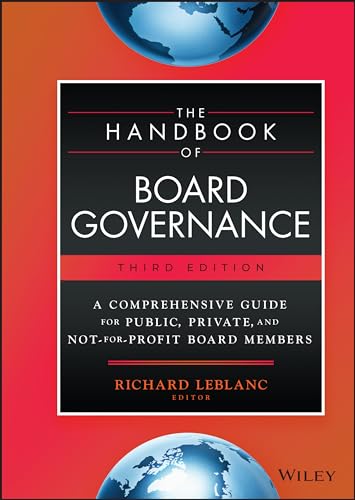
The handbook of board governance : a comprehensive guide for public, private and not-for-profit board members / edited by Richard Leblanc.
Material type: TextPublisher: Hoboken, New Jersey : John Wiley & Sons, Inc., 2024Edition: Third editionDescription: lxxvi, 1476 pages ; 26 cmContent type:
 - text
- unmediated
- volume
- 9781119909279
- 658.422 H191 23
- HD2745 .H3634 2024
| Item type | Current library | Shelving location | Call number | Copy number | Status | Date due | Barcode | |
|---|---|---|---|---|---|---|---|---|
 Books
Books
|
Main Library | Graduate School Library | GRD 658.422 H191 2024 (Browse shelf(Opens below)) | 1-1 | Available | 031497 |
Includes bibliographical references and index.
The board governance handbook: an introduction and overview -- I. Hiring, evaluating, and dismissing the CEO -- CEO succession planning -- Incrementalism is not going to work -- Model president and CEO position description -- Model president and CEO annual performance evaluation and incentive compensation policy -- Board oversight of possible CEO misconduct -- Model CEO succession planning charter -- II. Strategy and investors -- The three dilemmas for creating a long-term board -- Pension fund governance: working under tension -- A critique of the investment fund governance regime in Canada -- Third stage corporate governance: investors and companies divided by a common language -- III. Technology governance -- Technology and the corporate board: critical considerations going forward -- Questions the board should ask about artificial intelligence -- Artificial intelligence governance standards -- Fair warning has been given: what do directors need to do now to respond to cyber risk? -- Cyber risk from an IT leader's point of view -- Cyber legislation, standards, and practices: an overview for directors -- IV. Environment, social, and governance -- Environmental, social, and governance issues and the board -- ESG'S growing pains -- Shareholders, stakeholders, and tangible and intangible capitals -- Responsible boards for a sustainable future: not ESG but G(EES) -- Board oversight and climate change: what directors need to know -- Business reconciliation: calls to action #92 board and business imperative -- CEO political activism: corporate governance and ethical dimensions -- Business and the social agenda: C-suite activism, corporate responsibility, workplace trust, and the board's role -- A CPA's primer on EDI: what directors should know about equity, diversity, and inclusion audits -- Making diversity work -- An introduction to regenerative governance -- V. Financial governance -- Financial literacy and audit committees: a primer for directors and audit committee members -- What every director needs to know about insolvency -- Ten telltale signs of possible fraud: a director's primer -- Scary financial reporting issues for directors -- VI. Emergency and crisis governance -- Considerations for emergency board succession planning under the worst-case scenario -- COVID-19 and beyond: the persistence of intersectionality in management: reflections for management in a post-pandemic world -- Preparing for governance of complex disasters: social dimensions, knowledge systems, and systemic mitigations -- Disaster management and risk assessment -- VII. Risk governance -- Risk oversight for directors: a practical guide -- Risk governance: leading practice and demographic impacts -- Board risk and responsibility under regulatory and criminal law -- VIII. Human capital and compensation governance -- Winter is closer: the approaching ESG and human capital management reporting storm -- Measuring and assessing employee value added: board oversight of human capital -- Missing in action no longer: why human resources is integral to the corporate boardroom agenda -- Questions boards should discuss before adding or modifying ESG goals in executive incentives -- Measuring and improving pay for performance: board oversight of executive pay -- Lawyers' advice to directors on overseeing executive pay -- The effective compensation committee -- IX. Legal, ethical, and conduct governance -- Model individual director position description -- Fifty question areas when conducting a governance audit or investigation -- Model director code of conduct and conflict of interest policy -- A board's responsibility for enterprise risk and cultural oversight: a closer look at chiberl health -- X. Board leadership -- The changing nature of the board chair's role -- Model chair of the board position description -- Model committee chair position description -- Model board of directors' guidelines -- Mission-critical checklists for directors -- Model guidelines for in-camera and closed sessions of the board of directors and committees of the board -- Model board of directors virtual and hybrid meeting and work from policy -- Asking good questions as a director -- XI. Board structure, composition, and effectiveness -- Re-empowering the control function of boards -- Administering a director competency and attribute matrix -- Wisdom and the board: seeking and developing wise leadership -- Model director orientation policy -- Model director education policy -- Understanding groupthink to manage teamwork effectively within boards of directors -- Groupthink and its impact on board work -- The seasons of a director's effectiveness -- XII. Not-for-profit, private, and state-owned enterprise governance -- A primer on charitable and not-for-profit organization governance -- Some observations on the governance challenges of boards of directors of small not-for-profit organizations -- The best of boards, the worst of boards: the not-for-profit experience -- Model fundraising practices for not-for-profit boards of directors -- Advice for current and prospective directors of start-ups and early-stage companies -- Data protection and cost of compliance: the reality of small and medium-sized enterprises -- The ABCs (agencies, boards, and committees) of government -- XIII. International corporate governance -- External and internal corporate governance mechanisms in emerging markets -- Making the most of board evaluations: an overview of board evaluation practices in the U.S. and globally -- Evaluation that enhance board effectiveness -- Cross-border corporate governance -- ESG disclosure by privately held companies: learning from a case study of a Brazilian joint venture -- The Russian corporate governance story.
"The Handbook of Board Governanceprovides comprehensive coverage of all topics in corporate governance by subject matter experts. The chapter authors are a combination of practitioners (directors, management, advisors) and academics. The practitioners will bring practical experience and the academics will bring rigor and proximity to the literature. Topics covered include: value creation and the strategic role of the Board; risk governance and the oversight by the board; board composition and diversity; role of the board chair; blindspots and trendspotting in the boardroom; audit committee effectiveness; and much, MUCH more"-- Provided by publisher.
There are no comments on this title.