
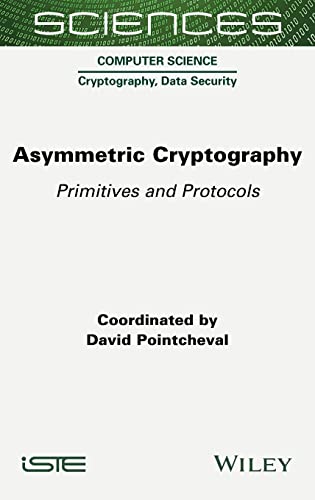
Asymmetric cryptography : primitives and protocols / coordinated by David Pointcheval.
Material type: TextSeries: Sciences. Computer science. Cryptography, data securityPublisher: London ; Hoboken, NJ : ISTE Ltd / John Wiley and Sons Inc., 2022Description: xii, 286 pages ; 24 cmContent type:
 - text
- unmediated
- volume
- 9781789450965
- 005.824 As99
- QA76.9.A25 A83 2022
| Item type | Current library | Shelving location | Call number | Copy number | Status | Date due | Barcode | |
|---|---|---|---|---|---|---|---|---|
 Books
Books
|
Main Library | Circulation Section | CIR 005.824 As99 2022 (Browse shelf(Opens below)) | 1-1 | Available | 029322 |
Includes bibliographical references and index.
Public-key encryption and security notions -- Signatures and security notions -- Zero-knowledge proofs -- Secure multiparty computation -- Pairing-based cryptography -- Broadcast encryption and traitor tracing -- Attribute-based encryption -- Advanced signatures -- Key exchange -- Password authenticated key exchange: protocols and security models -- Verifiable computation and succinct arguments for NP.
Public key cryptography was introduced by Diffie and Hellman in 1976, and it was soon followed by concrete instantiations of public-key encryption and signatures; these led to an entirely new field of research with formal definitions and security models. Since then, impressive tools have been developed with seemingly magical properties, including those that exploit the rich structure of pairings on elliptic curves. Asymmetric Cryptography starts by presenting encryption and signatures, the basic primitives in public-key cryptography. It goes on to explain the notion of provable security, which formally defines what "secure" means in terms of a cryptographic scheme. A selection of famous families of protocols are then described, including zero-knowledge proofs, multi-party computation and key exchange. After a general introduction to pairing-based cryptography, this book presents advanced cryptographic schemes for confidentiality and authentication with additional properties such as anonymous signatures and multi-recipient encryption schemes. Finally, it details the more recent topic of verifiable computation
There are no comments on this title.