
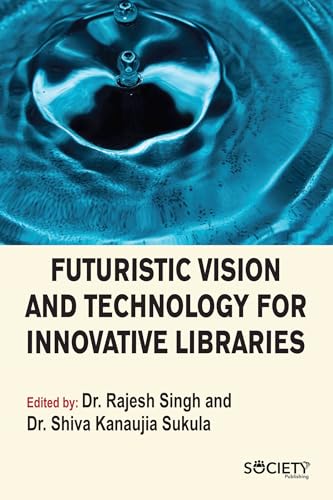
Futuristic vision and technology for innovative libraries / edited by Rajesh Singh and Shiva Kanaujia Sukula.
Material type: TextPublisher: Burlington, Ontario : Society Publishing, 2024Description: xlii, 545 pages : illustrations ; 24 cmContent type:
 - text
- unmediated
- volume
- 9781774699577
- 027.7 F989 23
- Z675.U5 .F88 2024
| Item type | Current library | Shelving location | Call number | Copy number | Status | Date due | Barcode | |
|---|---|---|---|---|---|---|---|---|
 Books
Books
|
Main Library | Circulation Section | CIR 027.7 F989 2024 (Browse shelf(Opens below)) | 1-1 | Available | 031375 |
Includes bibliographical references and index.
Part I. Management models and framework library services -- Best practices in college libraries: a study with special reference to Dr. Ambedkar First Grade (Grant-in-Aid) college Shorapur, Yadagir district, Karnataka state -- ICT-based best practices and changing role of Librarian in academic library management -- Contribution of foreign authors in Indian origin DESIDOC journal of library and information technology based on Scopus database during periods 2012-2022: a scientometrics study -- Impact of e-resources and evidence based library services in educational institutions -- Design and development of user-centered services at Mirza Mehmood beg library, Zakir Husain Delhi College (University of Delhi), New Delhi: a study -- Content analysis of library website of top 10 colleges all India NIRF ranking 2022 University of Delhi: a study -- Digital tools for library professionals -- Part II. Technology, policy, and innovation -- AI chatbots in academic libraries: challenges, opportunities, and best practices -- Blended learning: changing shape of teaching and learning in higher education -- The strategic use of online scholarly tools in libraries around digital inclusion -- Distribution of knowledge using electronic information resources and services by Shrimati Hansa Mehta library Maharaja Sayajirao University of Baroda Gujarat India -- DESIDOC journal of library and information technology: a bibliometric analysis during 2012-2021 -- Implications and applications of artificial intelligence and robotics in Academic library services -- Reinventing academic library spaces in the IT era: the library as a social space on campus -- Curriculum development and learning in library and information science (LIS): a review -- Implementation of Panjab University electronic theses and dissertation repository (PU@ETD) -- Libraries as centers of continuing education: current trends -- Open education resources and constructivism: few perspectives from learning and libraries -- Tools and policies to identify plagiarism -- Cloud computing and Ranganathan's laws of the library science: an overview -- Assessment of the constraints in the provision and utilization of electronic information resources in Nigerian Polytechnics -- University library: a learning source of higher education in India -- Library services provided by Kendriya Vidyalaya libraries using
online tools during the COVID-19 pandemic: a survey -- Impact of emerging technologies on LIS professional development -- Plagiarism detection tools: an overview -- Pareto's principle - evidence-based acquisition for library consortia with special reference to "one nation, one subscription" -- Surplus of errors or ease of referencing, where accuracy stands in citation tools -- Part III. Vision and roles of the future academic libraries -- Exploring the roles and responsibilities of school librarians in Indian context -- Gamification: a current and future trend in academic libraries -- An empirical study of the eco-friendly green library: a haven for sustainability and learning -- Role of academic libraries in implementation of national education policy 2020 -- NEP and higher education: issues and challenge -- Data visualization of braille literacy research literature -- Role of librarians in achieving sustainable development Goal 4 - quality education with new age marketing skills -- Designing an accessible unit in academic library: a case study of Delhi University library system -- E-learning resources in academic libraries in the present scenario -- Modern libraries: technological issues and trend -- Human development, knowledge-economy, and libraries -- advancements in the use of artificial intelligence (Al) in academic libraries.
"A groundbreaking book that explores the exciting intersection of technology and libraries. With a visionary approach, it delves into the potential of cutting-edge technologies like artificial intelligence, virtual reality, and blockchain in transforming the way libraries operate and engage with their communities. This book provides a wealth of information, covering topics such as curriculum development, teaching methodologies, industry trends, and career opportunities. With contributions from experts in the field, it offers a well-rounded perspective on the subject. Whether you're a student, educator, or industry professional, this handbook is an essential resource. Gain key insights, expand your understanding, and enhance your skills in the dynamic and ever-growing field of tourism and hospitality education"-- Amazon.com.
"Digital in every sense, the libraries are transforming with significant leaps in technology taking place every day. Whereas the patrons are expecting libraries to provide a seamless, accessible experience, the libraries are finding new ways for sustainability, change management, and flexibilities by applying library standards. The edited book has been focusing on various management models and frameworks in library services. The theme has been introduced with a view to identify different models, standards, and tools which can be used to bring change in the ICT environment. It is expected to generate a large number of views from across the world which has far-reaching impact on developing the best out of all. The books especially focuses on faculty-student-library collaboration in all spheres of activities in the academic libraries. It underscores the collaboration of all stakeholders for holistic development of the academic library system. The content in the book also focuses on the institutional involvement in providing better manpower, better financial outlay based on the emerging practices. There has been much emphasis on the emerging management models for academic libraries; manpower structure in ICT environment; evolving ways and means for better relationship for working with faculty; user-centric services; reference and outreach; changes in emerging user characteristics, behaviors, and expectations; analyzing users' expectations in the emerging digital environment; information literacy and competency programs, e-tutorials along with best practices on modern library services"-- from page [4] of cover.
There are no comments on this title.