
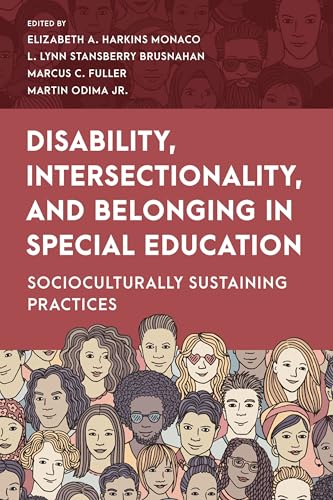
Disability, intersectionality, and belonging in special education : socioculturally sustaining practices / edited by Elizabeth A. Harkins Monaco, [and 3 others].
Material type: TextSeries: Special education law, policy, and practicePublisher: Lanham, Maryland : Rowman & Littlefield, 2024Description: xv, 433 pages ; 23 cmContent type:
 - text
- unmediated
- volume
- 9781538175828
- 371.9 D630 23/eng/20231127
- LC4015 .M584 2024
| Item type | Current library | Shelving location | Call number | Copy number | Status | Date due | Barcode | |
|---|---|---|---|---|---|---|---|---|
 Books
Books
|
Main Library | Circulation Section | CIR 371.9 D630 2024 (Browse shelf(Opens below)) | 1-1 | Available | 031160 |
Includes bibliographical references and index.
Part I: From the culture of disability to disability culture -- Historical and modern contexts of culture and the impact on belonging -- Intersectionality in the context of disability -- Disability culture in the deaf and autistic communities -- Part II: Critical theories that influence our views of disability and race -- Critical race theory: the dos, the don'ts, the already dones, and the stop doings -- The journey of disability studies: contemplating disability critically -- The history of disability, disability models, and a view for the future: the past is prologue -- Part III: Educational frameworks that champion equity -- Intersectional sociocultural competency and educational equity -- Socioculturally sustaining practices: the what, the why and the how -- Educational practices to acknowledge and incorporate students' sociocultural identities and experiences -- Part IV: Social and cultural rights movements that impact special education -- Disability rights: the impact of social and cultural movements on special education -- The push and pull of the litigation-legislation-litigation cycle -- Intersectional belonging in special education.
"This book focuses on preparing culturally competent educators who use culturally sustaining practices and culturally relevant curricula and instruction to reach and teach all students with disabilities including those with multiple social identities through a varied multi-cultural lens"-- Provided by publisher.
"Disability, Intersectionality, and Belonging in Special Education focuses on preparing educators who use socioculturally sustaining practices, curricula, and instruction through an intersectional lens. This book empowers preservice students and special education practitioners and administrators to meet the needs of disabled individuals. Understanding the full range of requirements relating to socioculturally sustaining practices is imperative to working with individuals with disabilities as well as with their families and caregivers. Being able to understand and explain this complex issue to others is important and often necessary. Social injustices in special education are historical and systemic. Special education practitioners are typically unaware of the importance of intersectional differences because they have been prepared to address cultural perspectives only during awareness days or through specific units in curricula. At other times they discuss the topic diagnostically--for example, as part of an educational plan or when teaching English as a second language. Other issues stem from the value system of the special education practitioners themselves; some are not willing to engage in these concepts, while others prioritize treating all students the same by using the terms "fairness," "equity," and "colorblindness" to justify this treatment. Even when special educator practitioners attempt to address injustices on behalf of their students, they tend to center on only the student's disability, which means they are ignoring or erasing other aspects of their students' identities. These concerns highlight the importance of building the sociocultural competence of our teaching force. This book will help practitioners build this competence in their own spheres of influence"-- Back cover.
There are no comments on this title.