
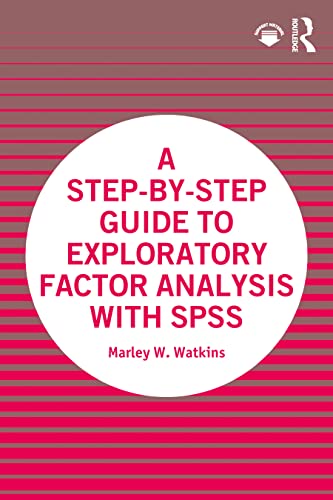
A step-by-step guide to exploratory factor analysis with SPSS / Marley W. Watkins.
Material type: TextPublisher: New York, NY ; Abingdon, Oxon : Routledge, 2021Description: xvii, 204 pages : illustrations (some color) ; 23 cmContent type:
 - text
- unmediated
- volume
- 9780367710316
- 519.5354 W322s 23
- QA278.5 .W383 2021
| Item type | Current library | Shelving location | Call number | Copy number | Status | Date due | Barcode | |
|---|---|---|---|---|---|---|---|---|
 Books
Books
|
Main Library | Circulation Section | CIR 519.5354 W322s 2021 (Browse shelf(Opens below)) | 1-2 | Available | 030939 | ||
|
Books
|
Main Library | Circulation Section | CIR 519.5354 W322s 2021 (Browse shelf(Opens below)) | 2-2 | Available | 030940 |
Includes bibliographical references and index.
Introduction: historical foundations -- Data -- SPSS software -- Importing and saving data -- Decision steps in exploratory factor analysis -- Step 1: Variables to include -- Step 2: Participants -- Step 3: data screening -- Step 4: Is exploratory factor analysis appropriate -- Step 5: Factor analysis model -- Step 6: Factor extraction method -- Step 7: How many factors to retain -- Step 8: Rotate factors -- Step 9: Interpret exploratory factor analysis results -- Step 10: Report exploratory factor analysis with categorical variables -- Higher-order and bifactor models -- Exploratory versus confirmatory factor analysis -- Practice exercises.
"This is a concise, easy to use, step-by-step guide for applied researchers conducting exploratory factor analysis (EFA) using SPSS. In this book, Dr. Watkins systematically reviews each decision step in EFA with screen shots and code from SPSS, and recommends evidence-based best practice procedures. This is an eminently applied, practical approach with few or no formulas and is aimed at readers with little to no mathematical background. Dr. Watkins maintains an accessible tone throughout and uses minimal jargon to help facilitate grasp of the key issues users will face while applying EFA, along with how to implement, interpret, and report results. Copious scholarly references and quotations are included to support the reader in responding to editorial reviews. This is a valuable resource for upper-level undergraduate and postgraduate students, as well as for more experienced researchers undertaking multivariate or structure equation modeling courses across the behavioral, medical, and social sciences"-- Provided by publisher.
There are no comments on this title.