
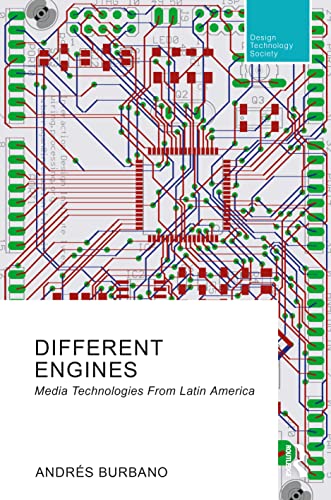
Different engines : media technologies from Latin America / Andrés Burbano.
Material type: TextSeries: Routledge research in design, technology and societyPublisher: Abingdon, Oxon ; New York, NY : Routledge, 2023Description: xii, 208 pages : illustrations ; 25 cmContent type:
 - text
- unmediated
- volume
- 9781032001111
- Media technologies from Latin America
- 302.23098 B891d 23
- P96.T422 L293 2023
| Item type | Current library | Shelving location | Call number | Copy number | Status | Date due | Barcode | |
|---|---|---|---|---|---|---|---|---|
 Books
Books
|
Main Library | Graduate School Library | GRD 302.23098 B891d 2023 (Browse shelf(Opens below)) | 1-2 | Available | 030290 | ||
|
Books
|
Main Library | Graduate School Library | GRD 302.23098 B891d 2023 (Browse shelf(Opens below)) | 2-2 | Available | 030291 |
Includes bibliographical references and index.
Introduction -- Part I. Backtracking -- Bioacoustics and photography, Brazil, 1832 -- The color wheel of television history, Mexico, 1939 -- COMDASUAR: a very personal computer, Chile, 1978 -- Part II. Sidetracking -- Lua: the scripting side of the moon, Brazil, 1993 -- Wiring: tangible interaction, intangible history, Italy, Colombia, 2003 -- Conclusions.
Different Engines investigates the emergence of technologies in Latin America to create images, sounds, video games, and physical interactions. The book contributes to the construction of a historiographical and theoretical framework for understanding the work of creators who have been geographically and historically marginalized through the study of five exemplary and yet relatively unknown artifacts built by engineers, scientists, artists, and innovators. It offers a broad and detailed view of the complex and sometimes unlikely conditions under which technological innovation is possible and of the problematic logics under which these innovations may come to be devalued as historically irrelevant. Through its focus on media technologies, the book presents the interactions between technological and artistic creativity, working towards a wider understanding of the shifts in both fields that have shaped current perceptions, practices, and design principles while bringing into view the personal, social, and geopolitical singularities embodied by particular devices. It will be an engaging and insightful read for scholars, researchers, and students across a wide range of disciplines, such as media studies, art and design, architecture, cultural history, and the digital humanities.
Andrés Burbano is Professor in the Arts and Humanities School at the Open University of Catalunya (Barcelona, Spain) and Visiting Lecturer at Donau-Universität (Krems, Austria). He holds a Ph.D. in Media Arts and Technology from the University of California at Santa Barbara (California, EEUU) and has developed most of his academic career in the School of Architecture and Design at Universidad de los Andes (Bogotá, Colombia). Burbano works as a researcher, curator, and interdisciplinary artist. His research projects focus on media history and media archaeology in Latin America and the Global South, 3D modeling of archaeological sites, and computational technologies' historical and cultural impact. Burbano has been appointed as ACM SIGGRAPH 2024 Chair.
There are no comments on this title.