
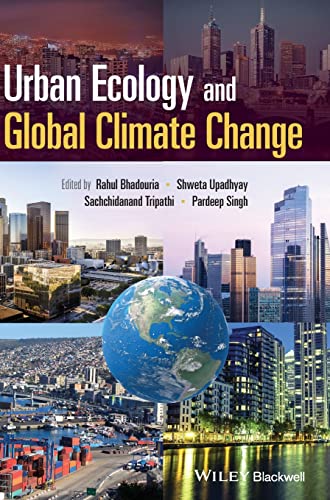
Urban ecology and global climate change / edited by Rahul Bhadouria, [and 3 others].
Material type: TextPublisher: Hoboken, New Jersey : Wiley-Blackwell, 2022Edition: First editionDescription: xvi, 351 pages : illustrations, maps ; 25 cmContent type:
 - text
- unmediated
- volume
- 9781119807186
- 577.56 Ur12 23/eng/20220112
- QH541.5.C6 U735 2022
| Item type | Current library | Shelving location | Call number | Copy number | Status | Date due | Barcode | |
|---|---|---|---|---|---|---|---|---|
 Books
Books
|
Main Library | Graduate School Library | GRD 577.56 Ur12 2022 (Browse shelf(Opens below)) | 1-1 | Available | 030246 |
Browsing Main Library shelves, Shelving location: Graduate School Library Close shelf browser (Hides shelf browser)

|

|

|

|

|

|
|
||
| GRD 519.54 G352n 2021 Nonparametric statistical inference / | GRD 550 H191 2015 Handbook of agricultural geophysics / | GRD 551.6 K526g 2022 Global climate change and human life / | GRD 577.56 Ur12 2022 Urban ecology and global climate change / | GRD 610.28 B521 2017 Biomaterials and nanotechnology for tissue engineering | GRD 610.28 K960b 2009 Bio-medical signal processing / | GRD 610.28 K960b 2009 Bio-medical signal processing / |
Includes bibliographical references and index.
Section 1. Urban ecology and global climate change: introduction -- Urban ecology and climate change: challenges and mitigation strategies -- Climate change, urbanisation, and their impact on increased occurrence of cardiometabolic syndrome -- Section 2. Urban landscape design using emerging techniques -- An alternative sustainable city framework to tackle climate change issues in India -- Integrated water resource management for future water security -- Water urbanism and multifunctional landscapes: case of Adyar River, Chennai, and Ganga River, Varanasi, India -- Urban landscape change detection using GIS and RS: Chattogram City corporation, Bangladesh -- Emerging techniques for urban resource restoration of various ecosystem: bioremediation, phytoremediation, habitat enhancement -- Phytoremediation of urban air pollutants: current status and challenges -- Section 3. Biodiversity and natural resource exploitation -- Tree benefits in urban environment and incidences of tree vandalism: a review for potential solutions -- Environmental status of green spaces in Bhaktapur district of Nepal - 2019 -- Challenges and opportunities of establishing jungle flora nursery in urban settlements -- Effect of the changing climate and urban ecology on spreading of infectious diseases including SARS-CoV-2 -- Human wildlife conflict in the Mumbai metropolitan region - an empirical study -- Section 4. Urbanisation, sustainable development goals (SDGs), and climate change -- Building knowledge on urban sustainability in the Czech Republic: a self-assessment approach -- A sustainable approach to combat climate change: case studies from some urban systems -- Section 5. Climate change and threats to ecological conservation -- Threats from sea level rise and erosion: a case study of an estuarine inhabited island Ghoramara, Hooghly estuary.
"Humankind is facing three major challenges viz. human overpopulation, urbanisation, and climate change with the onset of the twenty-first century (Steiner 2014). Presently, about seven billion (expected to reach 8.2 and 9 billion by 2025 and 2050, respectively) people are inhabiting the Earth which is more than any previous time. Urban areas and people living in the cities are increasing rapidly in size, globally (Mitchell et al. 2018). Over half (~54%) of the world's population is residing in the urban areas which is expected to grow to 60 and 80% by the year 2030 and 2050, respectively (Lee 2011; Vasishth 2015). Urbanisation phenomenon can be seen occurring on all the continents (except Antarctica); however, rapid urbanisation is happening, particularly in the Asia and Sub-Saharan Africa (Yu et al. 2017). Rapid urbanisation is putting severe stress on the planet Earth resulting in changes in the ecosystems from the landscape to the global scales (Steiner 2014; Colding and Barthel 2017)"-- Provided by publisher.
There are no comments on this title.