
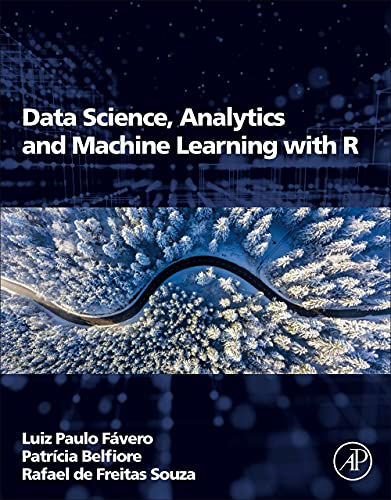
Data science, analytics and machine learning with R / Luiz Paulo Fávero, Patrícia Belfiore, and Rafael de Freitas Souza.
Material type: TextPublisher: London, United Kingdom ; San Diego, California : Academic Press, an imprint of Elsevier, 2023Edition: First editionDescription: xii, 648 pages : illustrations (black and white, and colour) ; 28 cmContent type:
 - text
- unmediated
- volume
- 9780128242711
- 658.05631 F278d 23
- HF1008 .F38 2023
| Item type | Current library | Shelving location | Call number | Copy number | Status | Date due | Barcode | |
|---|---|---|---|---|---|---|---|---|
 Books
Books
|
Main Library | Graduate School Library | GRD 658.05631 F278d 2023 (Browse shelf(Opens below)) | 1-2 | Available | 030255 | ||
|
Books
|
Main Library | Graduate School Library | GRD 658.05631 F278d 2023 (Browse shelf(Opens below)) | 2-2 | Available | 030256 |
Browsing Main Library shelves, Shelving location: Graduate School Library Close shelf browser (Hides shelf browser)

|

|

|

|
|

|

|
||
| GRD 658.049 L24i 2019 International management behavior : global and sustainable leadership / | GRD 658.049 M667g 2020 Global brand management : a guide to developing, building and managing an international brand / | GRD 658.05 St821 2020 Strategic digital transformation : a results-driven approach / | GRD 658.05631 F278d 2023 Data science, analytics and machine learning with R / | GRD 658.05631 F278d 2023 Data science, analytics and machine learning with R / | GRD 658.11 B219e 2016 Entrepreneurship the art, science, and process for success/ | GRD 658.11 F199b 2019 Brain versus capital : entrepreneurship for everyone lean, smart, simple / |
Includes bibliographic references and index.
I. Introduction -- Overview of data science, analytics, and machine learning -- Introduction to R-based language -- II. Applied statistics and data visualization -- Types of variables, measurement scales, and accuracy scales -- Univariate descriptive statistics -- Bivariate descriptive statistics -- Hypotheses tests -- Data visualization and multivariate graphs -- III. Data mining and preparation -- Webscraping and handcrafted robots -- Using application programming interfaces to collect data -- Managing data -- IV. Unsupervised machine learning techniques -- Cluster analysis -- Principal component factor analysis -- Simple and multiple correspondence analysis - V. Supervised machine learning techniques -- Simple and multiple regression models -- Binary and multinomial logistics -- Count-data and zero-inflated -- Generalized linear mixed models -- VI. Improving performance -- Support vector machines -- Classification and regression trees -- Boosting and bagging -- Random forests -- Artificial neural networks -- VII. Spatial analysis -- Working on shapefiles -- Dealing with simple feature objects -- Raster objects -- Exploratory spatial analysis -- VIII. Adding value to your work -- Enhanced and interactive graphs -- Dashboards with R.
Data Science, Analytics and Machine Learning with R explains the principles of data mining and machine learning techniques and accentuates the importance of applied and multivariate modeling. The book emphasizes the fundamentals of each technique, with step-by-step codes and real-world examples with data from areas such as medicine and health, biology, engineering, technology and related sciences. Examples use the most recent R language syntax, with recognized robust, widespread and current packages. Code scripts are exhaustively commented, making it clear to readers what happens in each command. For data collection, readers are instructed how to build their own robots from the very beginning. In addition, an entire chapter focuses on the concept of spatial analysis, allowing readers to build their own maps through geo-referenced data (such as in epidemiologic research) and some basic statistical techniques. Other chapters cover ensemble and uplift modeling and GLMM (Generalized Linear Mixed Models) estimations, both linear and nonlinear. -- Provided by publisher.
There are no comments on this title.