
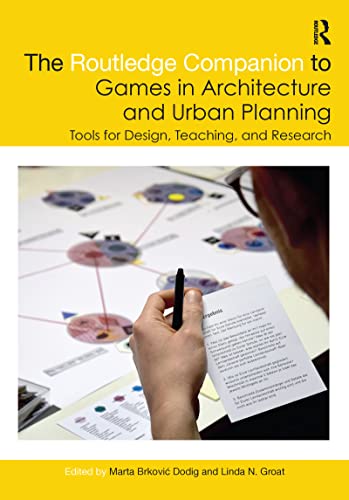
The Routledge companion to games in architecture and urban planning : tools for design, teaching, and research / edited by Marta Brković Dodig and Linda N. Groat.
Material type: TextPublisher: New York, NY ; Abingdon, Oxon : Routledge, 2020Description: xix, 253 pages : illustrations (some color) ; 27 cmContent type:
 - text
- unmediated
- volume
- 9781032084329
- 720.28 R765 23
- NA2790 .R68 2020
| Item type | Current library | Shelving location | Call number | Copy number | Status | Date due | Barcode | |
|---|---|---|---|---|---|---|---|---|
 Books
Books
|
Main Library | Engineering Section | ENG 720.28 R765 2020 (Browse shelf(Opens below)) | 1-1 | Available | 029862 |
Browsing Main Library shelves, Shelving location: Engineering Section Close shelf browser (Hides shelf browser)

|

|

|

|

|

|

|
||
| ENG 720.1 C917a 2020 Architecture : a global approach / | ENG 720.103 L585d 2020 Design and order : perceptual experience of built form principles in the planning and making of place / | ENG 720.228 C760a 2010 Architecture model building : tools, techniques, and materials / | ENG 720.28 R765 2020 The Routledge companion to games in architecture and urban planning : tools for design, teaching, and research / | ENG 720.28 St56r 2021 Residential design using AutoCAD 2022 / | ENG 720.284 Ab834a 2021 The art of city sketching : a field manual / | ENG 720.284 C441a 2015 Architectural graphics / |
Includes bibliographical references and index.
Architecture and urban planning? Game on!: games as tools for design, teaching/learning, and research in architecture and urban planning -- Part I. (Co)-design games -- Room for play in architecture: participatory games and game-like tools in architecture developed by die baupiloten -- Urban transition: games are political: challenging municipal urban planning practices for sustainable development and mutual learning through game co-designing -- The office scrabble game: co-designing workspaces with the everyday as a resource in design games -- Part II. (Co)-design and educational games -- Playing pretend: an interview with Steven Mankouche -- The architecture of scarcity game: the pedagogy of scarce design process -- The world of energy games -- Part III. Educational games -- Efargo energy challenge: architecture as a gaming board in pervasive energy games -- Urbanity: developing critical thinking about the urban environment through games -- Design as crossword-puzzle solving: the role of game in merging research and design -- The modern architecture game: a learning tool about modern architecture history for an international audience -- Part IV. Educational and research games -- Energy geogame 'e-footprints': prototype designed to collect data about human behavior in built environments -- Spector - the sustainability inspector: learning, teaching, and evaluation through a participatory and exploratory game -- Part V. Research games -- Reversing the co-design process: co-design games for post-occupancy evaluation -- Part VI. (Co)-design, educational, and research games -- The sorting task: its versatility and adaptability in research, teaching, and practice -- Games as urban agora: an analysis of games as participatory research, co-design, and educational tools in urban planning -- The role of gaming in community engagement: case study of a studio focused on societal challenges.
"The Routledge Companion for Games in Architecture and Urban Planning aims to identify and showcase the rich diversity of games, including: simulation games, game-like approaches, game scenarios, and gamification processes for teaching/learning, design and research in architecture and urban planning. This collection creates an opportunity for exchange and reflection on games in architecture and urban planning. Theoretical discussions, descriptive accounts, and case studies presenting empirical evidence are featured; combined with reflections, constructive critical analysis, discussions of connections, and various influences on this field. 28 international contributors have come together from 11 countries and 5 continents to present their studies on games in architecture and urban planning, pose new questions, and advocate for innovative perspectives"-- Provided by publisher.
There are no comments on this title.