
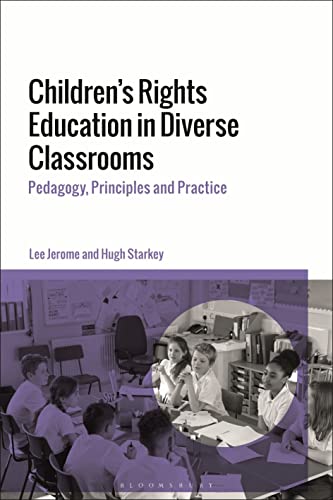
Children's rights education in diverse classrooms : pedagogy, principles, and practice / Lee Jerome and Hugh Starkey.
Material type: TextPublisher: London ; New York, NY : Bloomsbury Academic, 2021Description: xvi, 289 pages ; 23 cmContent type:
 - text
- unmediated
- volume
- 9781350216839
- 379.26 J483c 23
- LC213 .J47 2021
| Item type | Current library | Shelving location | Call number | Copy number | Status | Date due | Barcode | |
|---|---|---|---|---|---|---|---|---|
 Books
Books
|
Main Library | Circulation Section | CIR 379.26 J483c 2021 (Browse shelf(Opens below)) | 1-2 | Available | 027280 | ||
|
Books
|
Main Library | Circulation Section | CIR 379.26 J483c 2021 (Browse shelf(Opens below)) | 2-2 | Available | 030464 |
Includes bibliographical references and index.
Part I. Definition and developments -- The united nations convention on the rights of the child and some implications for education -- Defining children's rights education -- Implementing children's rights education -- Part II. Ideology and interpretations -- Children's rights education, ideology and the teacher as change agent -- Transformational education and pedagogy as politics -- Experiential education through democracy and cooperation -- Part III. Pedagogy and practice -- The rights-respecting classroom -- Developing a children's rights culture in the school -- Children as citizens -- Conclusion: towards a pedagogy for CRE.
"With PISA tables, accountability, and performance management pulling educators in one direction, and the understanding that education is a social process embedded in cultural contexts, tailored to meet the needs and challenges of individuals and communities in another, it is easy to end up in seeing teachers as positioned as opponents to the 'system'. Jerome and Starkey argue that the United Nations Convention on the Rights of the Child (UNCRC, 1989) can provide a pragmatic starting point for educators to challenge some of these unsettling trends in a way which does not set up unnecessary opposition with policy-makers. They review the evidence from international evaluations, surveys and case studies about practice in human rights and child right education before exploring the key principles of transformative and experiential education to offer a robust theoretical framework that can guide the development of child rights education. They also draw out practical implications and outline a series of teaching and learning approaches that are values informed, aligned with children's rights and focused on quality learning"-- Provided by publisher.
There are no comments on this title.