
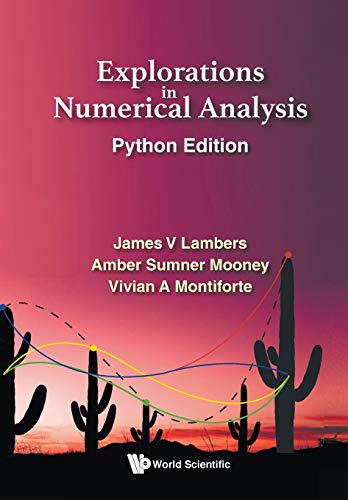
Explorations in numerical analysis : python edition / James V. Lambers, Amber Sumner Mooney, and Vivian A. Montiforte.
Material type: TextPublisher: New Jersey : World Scientific Publishing Co., 2021Description: xv, 674 pages ; 26 cmContent type:
 - text
- unmediated
- volume
- 9789811229343
- 518.02855133 L171e
- QA297 .L336 2021
| Item type | Current library | Shelving location | Call number | Copy number | Status | Date due | Barcode | |
|---|---|---|---|---|---|---|---|---|
 Books
Books
|
Main Library | Circulation Section | CIR 518.02855133 L171e 2021 (Browse shelf(Opens below)) | 1-1 | Available | 025603 |
Includes bibliographical references (pages 657-666) and index.
Part I Preliminaries -- 1. What is numerical analysis? -- 2. Understanding error -- Part II Numerical linear algebra -- 3. Direct methods for linear systems -- 4. Least squares problems -- 5. Iterative methods for linear systems -- 6. Eigenvalue problems -- Part III Data fitting and function approximation -- 7. Polynomial interpolation -- 8. Approximation of functions -- Part IV Nonlinear equations and optimization -- 10. Zeros of nonlinear functions -- 11. Optimization -- Part V Differential equations -- 12. Initial value problems -- Two-point boundary value problems -- 14. Partial differential equations.
"This textbook is intended to introduce advanced undergraduate and early-career graduate students to the field of numerical analysis. This field pertains to the design, analysis, and implementation of algorithms for the approximate solution of mathematical problems that arise in applications spanning science and engineering, and are not practical to solve using analytical techniques such as those taught in courses in calculus, linear algebra or differential equations. Topics covered include computer arithmetic, error analysis, solution of systems of linear equations, least squares problems, eigenvalue problems, nonlinear equations, optimization, polynomial interpolation and approximation, numerical differentiation and integration, ordinary differential equations, and partial differential equations. For each problem considered, the presentation includes the derivation of solution techniques, analysis of their efficiency, accuracy and robustness, and details of their implementation, illustrated through the Python programming language. This text is suitable for a year-long sequence in numerical analysis, and can also be used for a one-semester course in numerical linear algebra"-- Provided by publisher.
There are no comments on this title.